Geography
Maps & Places
Continents, countries, landmarks—build a mental map piece by piece.
Ages 6–12
Spatial reasoning
Memory
Where Learning Meets Play
Discover Street • Learn Through Play
Puzzles are one of the best “quiet superpowers” for kids and families: they build focus, patience, pattern recognition, spatial reasoning, and problem-solving—without feeling like school. Discover Street puzzles are designed as learning tools first (maps, timelines, science scenes, story worlds), and products second.
A visual learning puzzle with a kid-friendly story guide.
Choose what you want to learn. Each path includes a quick intro, a few easy wins, and optional “hands-on” puzzles.
Continents, countries, landmarks—build a mental map piece by piece.
Make complex systems feel simple using visuals and patterns.
See eras and stories as connected scenes, not isolated facts.
Build confidence with small wins: patterns, sequences, and strategy.
This page is a learning hub first. If you want to shop, the featured puzzle section is below—but most families start here.
Puzzles teach kids to rotate shapes mentally, notice edges, and build a “whole picture” from parts. This supports map reading, geometry, and even early engineering thinking.
Explore: Spatial reasoning explained • Hands-on: Map puzzles
A puzzle is a gentle focus trainer. Kids learn to stay with a task, recover from mistakes, and feel the reward of progress. That “I did it” moment matters.
Try: Focus-friendly activities • Guide: Choosing the right difficulty
Whether it’s colors, borders, textures, or sequences, puzzles help kids spot patterns—one of the foundations for reading, math, and scientific thinking.
Read: Patterns for kids • Explore: Science puzzles
Puzzles invite teamwork: “You do the edges, I’ll do the sky.” They create low-pressure conversation and shared wins, which is perfect for families.
Try: Family learning ideas • Explore: Large-format puzzles
If a child quits quickly, it’s usually not motivation—it’s mismatch. Pick a puzzle that offers visible progress every few minutes. Use “chunking”: edges → big shapes → details.
Read the full difficulty guide →Curated puzzles designed as learning tools. Each one includes a short guide and optional “next steps.”
A continent-first map puzzle designed to teach where things are and how they connect—without overwhelming detail.
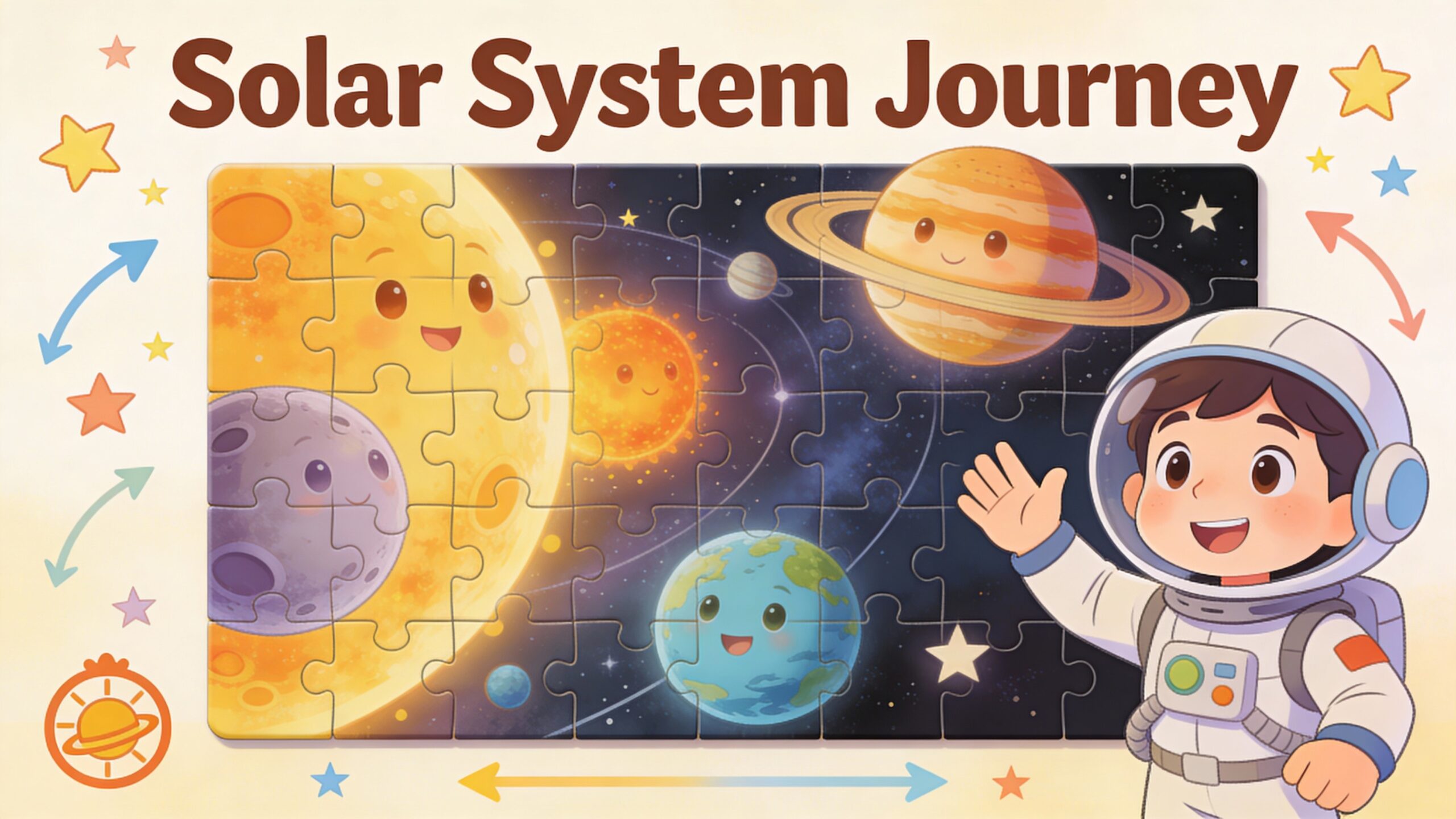
Assemble planets by size and distance, then use the included story prompts to “travel” outward from the Sun.
A timeline puzzle that visually separates Triassic, Jurassic, and Cretaceous—then ties each era to big changes.
A “layers” style puzzle that teaches major organs and systems using simplified visuals and a guided build order.
Age is only a starting point—interest and confidence matter more. Use these as friendly ranges, not strict rules.
Big pieces, clear shapes, fast wins.
More detail, still manageable.
Big growth zone for focus and strategy.
Deep detail, longer builds, richer learning.
Topic hubs are content-first destinations: intros, guides, activities, then optional puzzles.
Different formats teach different skills. Pick the “feel” your family enjoys most.
Classic builds focused on maps, scenes, and systems.
Explore →Build the past in order—eras, civilizations, and sequences.
Explore →See inside systems by building layers.
Explore →Short challenges designed for confidence and focus.
Explore →Bigger scenes—great for collaboration.
Explore →Name-based story puzzles, custom maps, “your world” scenes.
Explore →Practical answers from real families: how to choose, how to help, and how to make puzzles fun.
A 3-minute method to avoid frustration and build confidence fast.
Edges → chunks → connectors → details. Turn “stuck” into progress.
Ages 4–6, 6–8, 8–10, 10–14+: what to expect and how to help.
Simple habits and tools to keep puzzles inviting instead of messy.
Fast answers that help families choose wisely and enjoy the process.
Most 6-year-olds do best with 60–200 pieces depending on confidence and interest. Choose clear images, high contrast, and scenes that can be “chunked” into big areas (sky, ocean, continents, dinosaurs, etc.).
See: Puzzles by age • Guide: Difficulty guide
Yes—especially puzzles designed around maps, systems, timelines, and story scenes. The biggest gains are spatial reasoning, pattern recognition, persistence, and collaboration. Topic puzzles also build real knowledge when paired with a short guide or follow-up activity.
Start: Learning paths
If progress is invisible for long stretches, kids often quit. Too much repeating texture (all blue sky), low contrast, tiny pieces, or abstract imagery can be discouraging. A better puzzle offers frequent wins every few minutes.
Yes—weekly challenges, mini logic puzzles, and printable activities that support the same learning paths.
Visit: Free puzzle printables